Category: Uncategorized

  • Twenty Years of Small Biz Survival

    Twenty Years of Small Biz Survival

    Twenty years ago today, I hit “publish” on the first post here at SmallBizSurvival.com. I was sitting in the backroom of my liquor store in Alva, Oklahoma, population at the time of just under 5,000 and dropping. That very first post asked: ‘Can you build a growing small business in a declining small town?’ I’ve […]

    Twenty years ago today, I hit “publish” on the first post here at SmallBizSurvival.com.

    I was sitting in the backroom of my liquor store in Alva, Oklahoma, population at the time of just under 5,000 and dropping.

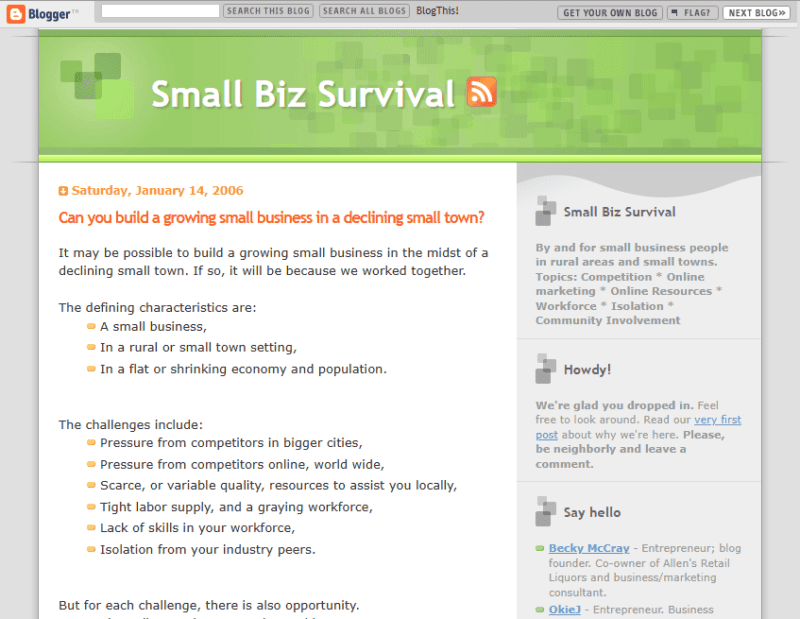
    That very first post asked: ‘Can you build a growing small business in a declining small town?’ I’ve spent twenty years proving the answer is yes.

    Screenshot of the first post at this blog, Small Biz Survival

    I started this blog because I’m a small town entrepreneur, and I believed then (still do) that small town entrepreneurs have a lot to teach other businesses. When local entrepreneurs prosper, they help their small town prosper, too.

    That was January 14, 2006. A lot has changed since then. A lot of other blogs have come and gone. But we’re still here.

    The People Who Made This Possible

    I can’t talk about twenty years without talking about the people who’ve contributed their knowledge, their stories, and their time to this rural corner of the internet.

    My mom, Glenna Mae Hendricks (Maesz), shared tax tips and accounting wisdom that helped so many small business owners sleep better at night. She’s since passed on, leaving a real legacy.

    Jeanne Cole was one of our earliest contributors, a friend from long before I started the blog who showed up when it mattered.

    Glenn Muske brought decades of Extension service experience and true expertise on micro-businesses.

    Deb Brown, my co-founder at SaveYour.Town, has contributed her retail knowledge and real-world small town business experience.

    And there have been so many guest contributors over the years: Jon Swanson, H.E. James, Zane Safrit, Barry Moltz, Sheila Scarborough, Marci Penner, John Warrillow, Shannon Ehlers and Scott Meyer.

    What Blogging Brought Me

    Here’s what I didn’t expect when I started: blogging was the step that made everything on my career goal list possible. (Of course I had a career goal list! If you know me, then you know.)

    Chris Brogan was my first blog friend. He got me involved in his early podcasting projects starting with Grasshopper New Media in 2006. Then other media ventures like Owner Magazine. He’s the one who convinced me to join Twitter in 2006 when it was brand new (my user number was 10,318), back before hashtags or even @ names existed. Chris is really the biggest reason blogging turned into more for me over the years. In 2020, he came back to guest post here. Thanks, Chris!

    Then there was Liz Strauss of Successful-Blog.com. She handed out Successful Outstanding Blogger awards and called us SOBs, which was hilarious. Liz connected me with so many other people. At her SOBCon event, I met Barry Moltz, who became my co-author for our award-winning book Small Town Rules. Liz got me early speaking roles at BlogWorld Expo in 2008 and ’09. We spoke together as a duo at SXSW in 2010. Rest in peace, Liz.

    Those connections led to more connections. Speaking opportunities. My work with Sheila Scarborough creating Tourism Currents. Eventually, the work Deb Brown and I do at SaveYour.Town. The Survey of Rural Challenges that started as a topic survey for this blog and has now reached over 2,200 rural folks. My second book The Idea Friendly Guide. Speaking engagements from local community centers to Harvard Kennedy School and international stages.

    None of that would have happened without me hitting publish on January 14, 2006.

    What We’ve Built Together

    The recognition has been humbling. Top 10 Best Small Business Blogs by Feedly and FeedSpot, as of today. Top 25 by Technorati for a brief moment during the height of the blog competition. Selected for syndication through LexisNexis, Thomson Business Intelligence, MyVenturePad. Named a Small Business Influencer multiple years running and a Power Player in Technology Business Media.

    Look how SmallBizSurvival had grown by 2008!

    Our long-running Brag Basket, where people shared their own successes. The podcasts, video streams and experiments. The thousands of posts from the practical to the fun.

    Guest columns at US News and World Report, SmallBusiness.com and SmallBizTrends.com. (SmallBizTrends also still plugging along after 20 years!) Getting to judge small business grant entries for Intuit. Attending conferences like the National Association of Seed and Venture Funds on a media pass.

    The emails from business owners who tried something they read here and it worked. The small town entrepreneurs who found practical advice they could actually use. The rural communities that discovered they weren’t alone.

    Still Here, Still Rural

    A lot has changed in twenty years of blogging and twenty years of rural entrepreneurship. But the core truth remains: small towns can thrive when their local businesses prosper.

    Alva’s population made a resurgence in the mid 2010s (just one more oil boom), before dropping back below 5,000. I don’t have the liquor store anymore, but I’m still writing from real experience, my own successes and failures as a lifelong entrepreneur. Still focused on practical steps you can put into action right away. Still believing that when you take care of your business, you’re taking care of your community.

    Here’s to the next twenty years of small biz survival.

    Thanks for being part of this journey.

  • Get more customers without advertising: Show up where they can find you

    Get more customers without advertising: Show up where they can find you

    How the Roofer Nailed Marketing Guest Post by Chris Brogan Let me tell you about an experience I had in a little diner in Lewiston, Maine. I sat at the counter of a busy Maine diner slinging breakfast to a crowd of mostly locals, it seemed. One guy a few seats away from me did […]

    How the Roofer Nailed Marketing

    Two diverse workers installing new shingles on a roof. One worker in a red shirt cuts a shingle. A woman uses a push hoe to remove nails and debris.

    Photo by Becky McCray.

    Guest Post by Chris Brogan

    Let me tell you about an experience I had in a little diner in Lewiston, Maine.

    I sat at the counter of a busy Maine diner slinging breakfast to a crowd of mostly locals, it seemed. One guy a few seats away from me did roof work. I know this because over the course of my meal, maybe eight different people interrupted him to ask him to check out a job they had in mind for him.

    I couldn’t ignore any of this, so I asked, “I don’t want to interrupt, but you sure are getting a lot of business just sitting here at the counter. You don’t advertise or anything, do you?”

    “Nope,” he said, pushing some eggs into his mouth and chewing for a little. “I come here for breakfast and lunch every single day they’re open. And every day, someone asks me if I can look at a job. Easy as that.”

  • Local Products Make the Best Swag

    Local Products Make the Best Swag

    Jim Katzman wrote a great article on Medium about creating swag that customers actually want. One of his tips was “Leverage Local Pride.” That got me thinking: Local products would make the best swag. Local products are easier Instead of designing a batch of custom pens or ordering another lot of logo coffee mugs, walk […]

    Jim Katzman wrote a great article on Medium about creating swag that customers actually want. One of his tips was “Leverage Local Pride.”

    That got me thinking: Local products would make the best swag.

    Local products are easier

    Instead of designing a batch of custom pens or ordering another lot of logo coffee mugs, walk into a local shop and buy what they’ve got. Local honey. Locally made soap. Beef jerky from a nearby producer. A small art or craft piece.

    You skip the minimum order quantities and the wait time. You support another local business. And you hand people something they’ll actually use and remember.

    Whether you’re at a trade show, conference or heading to a special event, you can share your local flavor rather than “yet another water bottle.”

    People love local products

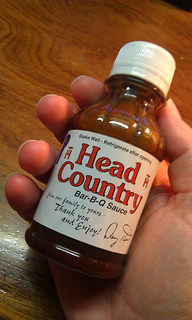
    Sample size Head Country barbecue sauce bottle

    A tasty sample from Head Country sauces in Ponca City that is easy to take home.

    I often give visitors Shawnee Mills cornbread mix packets when they come through Oklahoma or I visit them. Cornbread is an important cultural food to me. Even though I live a few hours from Shawnee, it’s local enough. And people love it when I share stories about my grandmother making cornbread.

    That’s what local products do. At their best, they tell a story about your place.

    Head Country BBQ Sauce in Ponca City, Oklahoma, once made mini 3-ounce bottles specifically as swag. Small enough to meet TSA liquid rules, so visitors could take it home even when flying.

    Make it yours and theirs

    You can co-brand if you want: add your sticker or tag to local sauces, seasoning mix, or whatever fits your business. Or just hand it over as-is with your business card (or your loyalty card).

    Those Head Country sample bottles included some promotional text about Ponca City, done in cooperation with their economic development team. (Go, Ponca!)

    Shawnee Mills actually does custom mixes, and that would be so much cooler than a generic water bottle with your logo.

    When I managed a liquor store and was participating in social media conferences, I took mini 50ml bottles of liquor, added a little card from Moo printers, and used that as my calling card. People would fight over them!

    A mini bottle of Whalers Rum with a mini card that says, "Yes I really run a liquor store" and listing my social media handles

    My liquor store business cards for social media events. Photo by Crystal Storm.

    It’s better marketing

    When you give someone local products, you’re not just promoting your business. You’re showing that you support other local businesses. That’s good marketing for you and good for your community.

    Next time you need swag, look local first

    Walk around your downtown. Check out local makers and producers. See what’s already on the shelves at local shops. Look regionally and check out “made in your state” products.

    You’ll find something better than another notebook, and you’ll be supporting the businesses around you at the same time.

    Subscribe to SmallBizSurvival.com

  • The End of Year Checklist for Small Businesses

    The End of Year Checklist for Small Businesses

    I’ve been in business a long time now, from retail to service to ag, and I’ve learned some things about wrapping up one year and getting ready for the next. Some of it I learned the hard way! Whether you run your business on paper, desktop software, mobile or cloud services, there are common tasks […]

    I’ve been in business a long time now, from retail to service to ag, and I’ve learned some things about wrapping up one year and getting ready for the next. Some of it I learned the hard way!

    Whether you run your business on paper, desktop software, mobile or cloud services, there are common tasks that need doing at year-end. Here’s your checklist.

    In a fabric store, a dark-skinned woman with long salt-and-pepper colored hair is using a laptop notebook to manage the business

    Time for those must-do end-of-year tasks! Photo by mavoimages via Depositphotos.

    Must do Jan 1

    These are the ones you can’t easily do later, so you don’t want to put them off.

    The good news: these are the easy ones.

    Count your inventory.

    If you sell or make products, take an inventory of all products and raw materials on hand at the turn of the year. You need the value of what it cost you. If you use a point-of-sale (POS) system, write down the end of year inventory total on January 1.

    Why you have to write it down: Most POS systems only keep a running (current) inventory total. If you forget to write it down now, you’ll have to figure backwards from all purchases and sales since Jan 1. Trust me, this is not a fun job.

    When I managed a liquor store, we took advantage of being closed on New Year’s Day to do a full count of our inventory and correct our POS records. It didn’t take long with one person counting, and one running the laptop to make corrections.

    Record end of year mileage.

    If you use your vehicle for business, write down your mileage at the end of the year. This provides an important baseline for your mileage records all year long. I always put this on my online calendar so I can find it easily.

    Get these done during January

    These are the tasks that need to be done soon, but don’t have to happen on January 1. But don’t let it slide, or you’ll pay for it with rushed days during tax filing season.

    How to get this done: Right now, commit time on each Friday during January to work through the checklist until you’re all finished.

    1. Financial Data

    Backup accounting data in two formats.

    Yes, this applies whether you use paper records, software, app or a cloud service. Every data service is subject to being interrupted at the worst possible time or even closing down with no warning.

    Hot tip: Do an export of the data in your accounting system’s backup format and then also in CSV. So if you use Quickbooks, let it back up in the special .qbw format, then do another backup in CSV.

    Run accounting reports in PDF.

    Run year-end financial reports as PDFs. If you need this data in a few years from now, it will be easy to look at a PDF report that shows the answer in an easy-to-read format. If all you have is a CSV, you’ll get to re-import it in whatever system you’re using then, reformat and clean up the data, then run a report to see the answer.

    This also gives you insurance against changes in your accounting service. I can’t even tell you how many different accounting services and programs I’ve used over the years!

    Here are the key year-end reports to run:

    • Profit and Loss, Jan 1 – Dec 31 (PDF)
    • Balance Sheet, dated Jan 1 and another dated Dec 31 (PDF)
    • Detail of every transaction, Jan 1 – Dec 31 (PDF, this will be long)
    • Export all data as a backup (standard and CSV)

    Run payroll reports.

    Save these as PDFs as well. Payroll reports are critical tax documents. Do not lose these.

    • Payroll details for each employee, Jan 1 – Dec 31 (PDF)
    • Payroll tax filings, Jan 1 – Dec 31 (PDF)
    • Export all data as a backup (standard and CSV)

    Download online banking and payment transactions.

    Make sure you have downloaded a PDF report of all transactions for the year. Your bank may restrict how long statements are available, so download all of last year’s bank statements now.

    • Banking statements
    • Online billpay details
    • All transactions in CSV

    It’s easy to overlook payments received via online services, so dig deep. Did you accept payments anywhere? Get a backup of that data.

    • PayPal
    • Square
    • Stripe
    • Venmo
    • Zelle
    • Cash App
    • Any online transaction processor

    Download copies of bills.

    We all do business in so many places that it’s tough to keep up. Since bank statements alone aren’t enough to satisfy the IRS, you’ll want PDFs of these and any other online financial data. Make a list of these so you can refer back to it next year.

    • Utility bills
    • Credit card statements
    • Insurance bills
    • Supplier invoices
    • Tax filings

    Update employee and contractor data.

    Do you have a current mailing address for every employee and former employee you paid during this year? You’ll need that when you issue your W2 forms.

    Many small businesses rely on independent contractors who may or may not live nearby. For US small businesses, you’ll need to send 1099 forms to each contractor you paid more than a few hundred during the year. (Check with a tax pro for the details.) One thing you can do right now is make sure you have updated data on your contractors.

    • Ask employees and former employees for any updates to their W-4 form or mailing address
    • Ask independent contractors for any updates to their W-9 form

    If you don’t have those W-4 or W-9 forms, now is the time to get them.

    2. Backup your data

    Download cloud files.

    Your small business probably relies on cloud solutions for collaboration, invoicing, email, and other key functions. Review your cloud services and download copies of all critical files and data. Make a list of your current cloud services to make this task easier again next year.

    • Password management (1Password, Bitwarden, etc.)
    • Contacts, customer lists
    • Google Drive/Docs
    • Microsoft OneDrive/Office 365
    • iCloud
    • Dropbox
    • Any cloud service with important data

    Download data from business platforms.

    If you use an online business platform like Shopify, Etsy, Podia, or Squarespace, download all your records and contacts.

    Do you have an email newsletter? Download your list of email addresses and all detail as a backup.

    If you use social media for your business, back up contacts, critical messages, and business transactions from Facebook Business Suite, Instagram, or other platforms.

    These platforms are always changing and vary widely, so use your judgment about what’s critical for your business. If figuring out all your platforms and data turns into a big job this year, make yourself a checklist so it’s easier next January.

    Run off your calendar.

    Your business calendar documents your travel, meetings and more related to your work. It’s a vital business record. If you use a paper planner, set a consistent and secure location to keep the old calendars available for at least five years. If you use an online calendar:

    • Save a PDF of your entire year’s calendar

    Then check the formatting, to be sure it’s readable. You probably have to break it down by month or by week, or even by day, in order to make all the detail visible.

    This one report has saved me so much trouble over the years. Always save your calendar.

    Back up your phone.

    Your phone holds critical business data: contacts, photos, and important messages. For most businesses, it’s probably enough to back up iPhones to iCloud and Android phones to Google Drive. Make sure that backup is current and includes your photos, contacts, and any critical business messages.

    Backup your files: don’t skip this

    You’ve just collected a lot of critical financial data for your business. Don’t risk losing those files.

    • Assemble all these files into a single folder dated with the year
    • Send a copy to cloud backup such as Google Drive, OneDrive, or Dropbox
    • Keep a copy on a USB thumb drive or an external hard drive separate from your computer

    That last step – the physical backup – is more important than ever. We all rely on cloud services now, but having your own copy means you’re protected if anything happens to those services or your computer. That’s another lesson I’ve learned the hard way!

    Subscribe to SmallBizSurvival.com

  • Use your loyalty card as your business card

    Use your loyalty card as your business card

    At the LaunchRuralOK Small Business Resource event in Alva, I overheard the owner of Millie Coffee from Fairview, Oklahoma, talking to a service provider she wanted to work with. She  apologized for not having business cards with her, then handed over her shop’s loyalty card instead. I looked over my shoulder and said out loud, […]

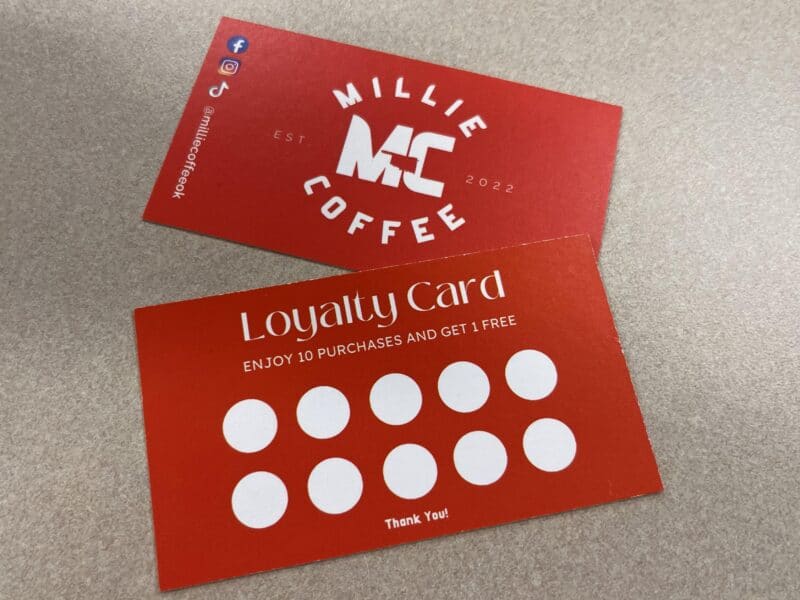
    A loyalty card from Millie Coffee

    Photo by Becky McCray

    At the LaunchRuralOK Small Business Resource event in Alva, I overheard the owner of Millie Coffee from Fairview, Oklahoma, talking to a service provider she wanted to work with. She  apologized for not having business cards with her, then handed over her shop’s loyalty card instead.

    I looked over my shoulder and said out loud, “That’s actually genius.”

    Here’s why her loyalty card beats a regular business card.

    It gives people a reason to visit

    A business card sits in someone’s pocket or gets filed away. Maybe they’ll call you someday. Maybe.

    A loyalty card? That’s an invitation with a built-in incentive. “Come see me at my shop. Get a punch. Come back again.”

    Bonus: Cross off one punch right there because they met you personally. You’re not just handing them a card. You’re starting a relationship and giving them credit for it.

    You’re already paying to print them

    Loyalty cards cost about the same as business cards. Why print two separate things when one card can do both jobs?

    Put your contact info on your loyalty card: phone number, address, email, hours, whatever you’d put on a business card. Now you’ve got one card that does double duty.

    Do you already have cards? 

    If you run a coffee shop, car wash, retail store, massage therapy business, hair salon, spa, ice cream shop, or any business where you want people to come back, you probably already have loyalty cards printed.

    Those are your business cards now.

    Start using them

    Grab a stack of your loyalty cards and take them to your next chamber meeting, networking event, or business gathering. Anywhere you’d normally hand out a business card, hand out your loyalty card instead.

    And when you order your next batch of loyalty cards, make sure your contact info is on there. You’ll have the most genius business cards in town.

  • How to be Idea Friendly – book review

    How to be Idea Friendly – book review

    I grew up in a small town in Maine, but I don’t think of myself as a small-town guy. My parents were involved in local community service groups. My Dad was the Cub Scout leader, a member of the Jaycees and the Elks club. And I remember helping him and other volunteers build a kiddie […]

    I grew up in a small town in Maine, but I don’t think of myself as a small-town guy.

    My parents were involved in local community service groups. My Dad was the Cub Scout leader, a member of the Jaycees and the Elks club. And I remember helping him and other volunteers build a kiddie pool, which literally changed the town park’s landscape.

    The town I live in now isn’t small. And while I’ve been part of our local theater and coached youth basketball, I am not nearly as involved as my parents were in shaping the future of the town I grew up in.

    Honestly, the idea of effecting change here seems more daunting; the thought of all the hoops, of filling forms, getting approval from committees, not to mention dealing with naysayers, doesn’t exactly inspire someone to take action.

    And then, I cracked open Becky McCray’s new book and read the beginning of the Idea Friendly Creed.

    “We are a community of possibilities, not of problems. We are action takers. We are optimistic.”

    Those lines alone got me nodding my head, and they set the stage for a book filled with everything the subtitle of The Idea Friendly Guide promises: “Practical, Immediate Steps to Break Free from Old-Way Thinking and Transform Your Community’s Future.”

    I’m also partial to some of the books’ more irreverent encouragement.

    “We don’t care about titles or who holds official positions. The people who do hold titles may not think like us. That’s ok. No one can stop us from doing the little things that really matter.”

    The Method 

    The Idea Friendly method is simple.

    “Gather Your Crowd with an idea that entices others.

    Build Connections to turn your crowd into a powerful network.

    Take Small Steps to accomplish your idea together.”

    A clear trash bag hanging from a bush near a riverbed, with several pieces of trash inside it

    Hang a trash bag where folks hang out, and they’ll use it. Social contract repaired. Photo by Rob Hatch.

    For years, I (and others) have been telling Becky that this method would work really well in all sorts of scenarios. She knows we’re right, but it’s really meant for you or for me to use to shape the future of our communities.

    A while back, I wrote about taking a trash bag with me to my local fishing spot to clean up some of the cans and other trash people left behind. I also hung a trash bag from a tree and filled it with a few cans to get things started. A few weeks later, it had more trash in it, rather than scattered on the ground.

    It was Becky and her method that inspired me to, in some small way, shape a tiny corner of my community. Because as the Idea Friendly Creed says,  “We create the moments that show what this town could be and the places that take our breath away, if only just for a moment. What we create doesn’t have to be permanent to create possibility.”

    I think that’s one of the things I appreciate most about Idea Friendly. That we can take small practical steps, that what we create can be measured in moments. And by creating those moments, those small wins, we have something we can build on.

    Of course, small towns need businesses to grow. I think that’s where Idea Friendly thrives because, as great as those start-up competitions and pitch contests might be, I think I prefer the Idea Friendly perspective.

    “We’d rather help 10 people try their own ideas than to hold a vote and tell everyone to support the “winner.” That might be more efficient, but efficiency isn’t our goal. Community is our goal. And we try everyone’s ideas.”

    Imagine a town (or any place) where community is the goal. Sounds like a good place to start a business.

    Have a great week.

    Rob

    P.S. Go grab a copy of The Idea Friendly Guide. It doesn’t matter if you’re not a small-town person; it’s a damn good book.

    Covers of the Idea Friendly Guide as ebook and paperback

  • Caring is a small town business advantage

    Caring is a small town business advantage

    By Stephanie Ward, Firefly Coaching Caring isn’t something you can do if you’re only using it as a tactic. You can’t fake caring, either you do or you don’t. The good news is that we all have the capacity to care. It’s a state of being that you can tap into, just like gratitude. We […]

    A woman smiling at the camera while standing in front of a clothing rack

    By Stephanie Ward, Firefly Coaching

    Caring isn’t something you can do if you’re only using it as a tactic.

    You can’t fake caring, either you do or you don’t.

    The good news is that we all have the capacity to care.

    It’s a state of being that you can tap into, just like gratitude.

    We would probably be more caring, more often, if we just thought about it.

    Like anything, it has to be a priority, something you are consciously thinking about and want to do.

    So how can you show potential clients, your current clients, and the people in your network that you care?

    Here are some ideas to get you started.

    1) Listen

    We all want to be heard. My favorite habit from Stephen Covey’s book, The 7 Habits of Highly Successful People, is Habit #5: First seek to understand, then to be understood.

    Listen deeply to people when you communicate with them. Make sure they feel that you hear them and clearly get what they are saying.

    2) Ask How It’s Going

    Ask your clients about their experience with your products and services. Ask them if they are satisfied, if they are receiving what they expected.

    If things aren’t up to snuff, do everything you can within your power to make the situation right. And then do even more to exceed their expectations.

    3) Offer Help

    If you see that someone is struggling with something, offer to help.

    Can you share a resource that will help? Make an introduction? Review something?

    Being helpful is a wonderful way to show you care.

    4) Check In

    Check in with people for no reason other than to say hello and see how they are doing.

    You can drop a note in the post, call, or send an email.

    5) Give Support & Encouragement

    If you know someone has an upcoming event, book launch, speaking gig, or an equivalently big deal on the horizon – send them a message of encouragement.

    Caring about the success of others is fun and easy to do.

    6) Share Their Work

    As the Salvation Army says, Sharing is Caring. If you care about someone, and the work she is doing, share it.

    Social media makes it a piece of cake to do. So take a few minutes to share the creations of others.

    7) Keep Your Promises

    In business, your word is everything. Caring about someone means keeping your promises.

    Keeping your promises builds trust and lets people know they can count on you.

    8) Say Thank You

    If someone does something kind for you, show you care by saying thank you.
    Showing your appreciation goes a long way and yet, it’s another thing we sometimes forget to do.

    The funny thing about caring about people is that in your effort to give, you will also receive. It feels good.

    How do you show people you care?

    © Stephanie Ward, reprinted by permission

    Photo PD by Alex Starnes, via nappy

    Stephanie Ward is the Marketing Coach for Entrepreneurs who want to create meaningful and prosperous businesses. Grab your FREE copy of the special report ’7 Steps to Attract More Clients in Less Time’ plus business building tips, at: .

    Which one of these ideas will you try? How do you show your clients you care? Share your experiences, thoughts, and questions in the comments section below.

  • Start smaller: Any local business can be your incubator

    Start smaller: Any local business can be your incubator

    Are you starting a business that could use retail space, but you can’t justify renting a storefront? Find a tiny space inside another business that can be your incubator. Who could display This can work for all kinds of physical-display businesses: Artists Crafts Authors Resellers Photographers Shelf stable foods and beverages Small manufacturers Agri-products like […]

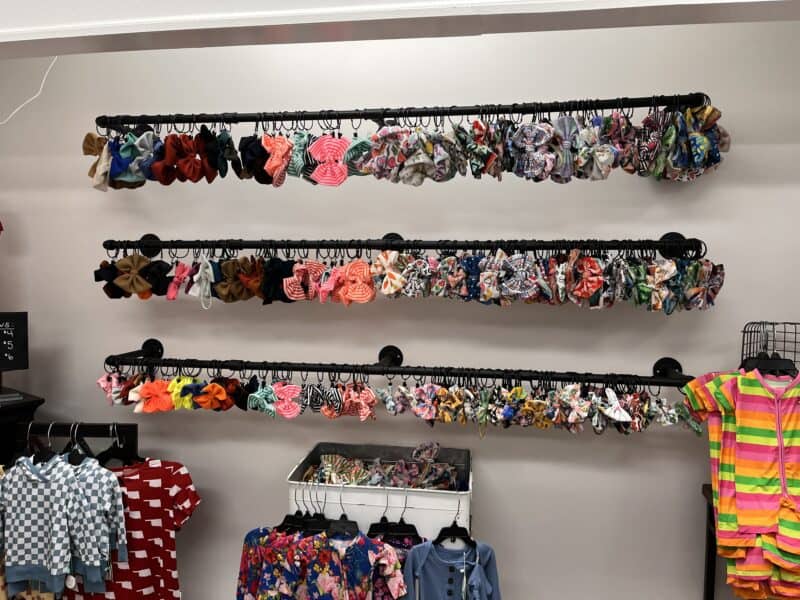
    Clothing displayed on one wall, with a salon in the back.

    Are you starting a business that could use retail space, but you can’t justify renting a storefront? Find a tiny space inside another business that can be your incubator.

    Who could display

    This can work for all kinds of physical-display businesses:

    • Artists
    • Crafts
    • Authors
    • Resellers
    • Photographers
    • Shelf stable foods and beverages
    • Small manufacturers
    • Agri-products like beeswax candles or goat milk skin care

    Who could host

    And any kind of bricks and mortar business could host:

    • Retail stores
    • Lodging
    • Coffee shops and restaurants
    • Services like insurance or legal offices
    • Cultural spaces like museums

    The host business doesn’t have to be related to the pop-up. In fact, when they’re not related, both sides benefit from exposure to both sets of customers.

    Many small town businesses struggle to keep enough merchandise on display to make the store feel full and vibrant. Adding a pop-up business can help fill out the interior.

    Together, you’re creating an experience for your customers that they can’t get anywhere else.

    See also: How do you get merchants to host pop-ups inside their business?

    Start with one wall, one shelf, one square foot of retail space. Here are some pictures to inspire your creativity.

    Photography in a clothing store

    photography in shared space in Gowrie Iowa

    It’s tough for retail stores to fill the space  near the ceiling, and any empty space makes a small town business look sparse. Solution: local photography display. Photo by Deb Brown


    One square-foot retail

    Beauty salons are natural business incubators. Salons always have other little businesses growing inside them because they have great foot traffic. This is an opportunity to do more with the same amount of space.

    Probably the smallest pop-up I’ve seen is this stack of headbands, crafted by a local high school senior raising money for her mission trip. It fit into one square foot of the retail counter.

    headbands for sale on a counter in a beauty salon

    You don’t need much to start small. Even one square foot of space may be enough. Photo by Becky McCray.


    The One Wall Bookstore

    I love the one-wall bookstore idea! How many times have people said your town is too small for a bookstore? You’re not too small for anything if it only needs one wall!

    Inside courtyard

    One wall of shelves made a flexible pop-up space inside The Village shops in Washington, Iowa. Photo by Cathy Lloyd


    A building of tiny shops

    Besides the one-wall kids’ bookshop, this building is divided into many different small retail shops.

    A wall of books outside two small retail gallery spaces

    Another one-wall bookstore, this time for kids books. Photo courtesy of Walker Mercantile, Woodward, Oklahoma


    Local art and photography

    Every local business (retail, service, office…) needs art on their walls. Every local artist needs to get in front of new customers. Put those together, and you have an amazingly easy local art project.

    Coffee shop with local art displayed on the walls

    Coffee shop Gathering Grounds displays local art on the walls in Avon, Minnesota. Photo by Deb Brown


    Fill just one shelf

    A local hobby farm doesn’t need a full retail store for their goat milk products. One section of an endcap display in the local pharmacy may be just right.

    This pharmacy obviously hosts a lot of different businesses. Photo by Deb Brown.


    Start ’em young

    Anyone with even a few products can display on a shelf. This high school student displayed insider their local salon.

    A shelf with a few skincare products and a price list.

    High school student Rebecca has her own shelf of skin care products inside a local salon. Photo by Deb Brown.


    Make a visual change from the host business

    Use a different type of flooring, and it will look like a store-within-a-store. Don’t miss the rack of books by the local author.

    This bakery hosts a pop-up decor business tucked into a corner and a book rack from a local author, in Webster City, Iowa. Photo by Becky McCray.


    Provide products that are hard to find locally

    For resellers, consider products that aren’t offered anywhere else in your town, like hardware items.

    A hardware display inside a grocery store

    Small towns double up: this aisle of the grocery store is a tiny hardware store. Photo by Deb Brown.


    Fill every corner

    Even lodging and B&Bs can host pop-ups.

    A small corner shelving unit holds a variety of small retail items.

    I caught this tiny store inside a B&B where I was staying. There’s a variety of vintage items, paper goods and more. Photo by Becky McCray.


    Add one shelving unit

    Two women browse a shelf with jars of food.

    Inside the Chickasaw Cultural Center, one shelving unit offers canned and packaged foods for sale. Photo by Becky McCray.


    Divide a building and share

    This clothier also has a full size coffee bar. Photo by Becky McCray.

    Subscribe to SmallBizSurvival.com

  • Hello world!

    Welcome to WordPress. This is your first post. Edit or delete it, then start writing!